Control over glue, wax, and thixotropic products with EcoRAM
Glues, waxes, and other thixotropic products require more control than classic liquids. When high-viscosity material is not pumped stably, it leads to pressure drops, pulsations, air entrainment, and unplanned downtime. With the Dürr EcoRAM, TLCA delivers these materials to your application process in a controlled, consistent, and uninterrupted manner.
Why thixotropic materials require extra control
Thixotropic products such as adhesives, waxes, pastes, and sealants react differently from standard coatings or liquids. They are often highly viscous, difficult to start, and sensitive to variations in pressure, temperature, and material feed. As a result, a traditional pump system can cause fluctuations in flow rate, pressure build-up, and application quality.
From pressure loss to stable material supply
When material is not supplied constantly, the operator must make more frequent corrections and the risk of process variation increases. Therefore, TLCA not only looks at the pump, but at the entire material supply, packaging, and application. This results in a solution that is tailored to the product and the production environment. Also read how TLCA approaches process stability via Process optimisation of paint supply and dosing.
What the Durr EcoRAM resolves in your process
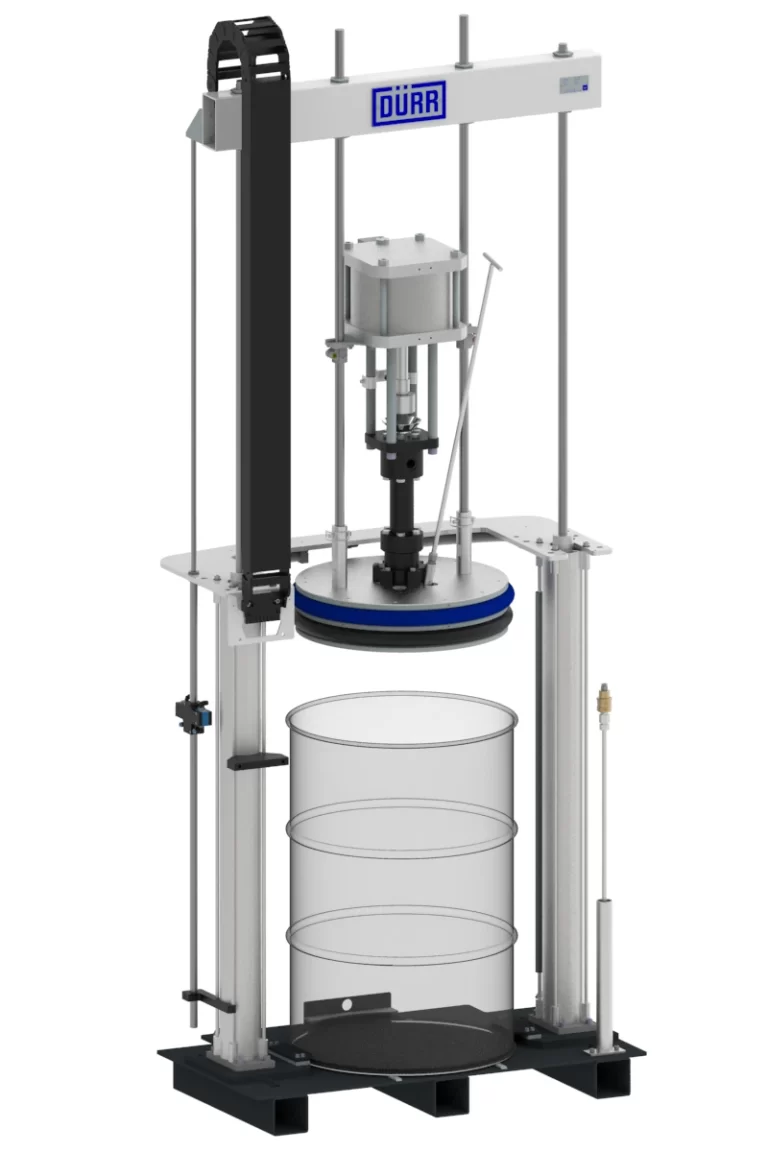
The Durr EcoRAM has been developed to process and transfer high-viscosity materials from drums to the application in a controlled manner. The system helps to maintain a stable flow rate, even when the product is difficult to pump. This makes the supply more reliable and reduces the risk of pulsations, air entrapment, and process interruptions.
Constant flow, less air intake and efficient tank emptying
A controlled material supply is essential when a constant flow is required. The EcoRAM supports efficient emptying of containers and limits material loss. This is particularly interesting for adhesives, waxes, and pastes where residual material, air entrapment, or pressure fluctuations can quickly affect quality, consumption, and downtime.
Applications for adhesives, waxes, and pastes
The EcoRAM is suitable for production environments where materials are not or are difficult to pump, where a stable supply is required, or where downtime during a drum change needs to be avoided as much as possible. Consider industrial adhesive applications, wax applications, sealing processes, and other applications with thixotropic products.
Configurations for 20 to 200 litre packaging
Depending on the product, viscosity, packaging and application, the EcoRAM can be supplied in various configurations for 20 to 200 litre packages. Optionally, a system can be built to enable changeovers without downtime, increasing process continuity.
Benefits for production, maintenance, and quality
For SMEs and industrial production companies, a stable material supply means fewer corrections, less process variation, and a more reliable output. The EcoRAM helps to process adhesives, waxes, and pastes in a controlled manner, empty containers optimally, and maintain more consistent application quality. This makes pump technology a direct lever for less downtime and more process reliability. More context about TLCA as a technical partner can be found at TLCA as a technical partner for industrial paint technology.
The Durr EcoRAM offers TLCA customers more control over adhesive, wax, and other thixotropic products. By delivering high-viscosity material stably, efficiently, and with less air entrapment to the process, downtime, corrections, and process variation are reduced. Have your material and application analysed to determine the correct EcoRAM configuration. Please contact us via contact TLCA.
FAQ
1) Why do glues, waxes and pastes require more control than classic liquids?
Because they are often highly viscous and react sensitively to variations in pressure, temperature and material feed.
2) What does the Durr EcoRAM solution dissolve in the process?
The system supports a stable flow rate and reduces the likelihood of pulsations, air ingress, and process interruptions.
3) For which packaging types are configurations possible?
Depending on the product and application, configurations are possible for 20 to 200-litre packaging.