
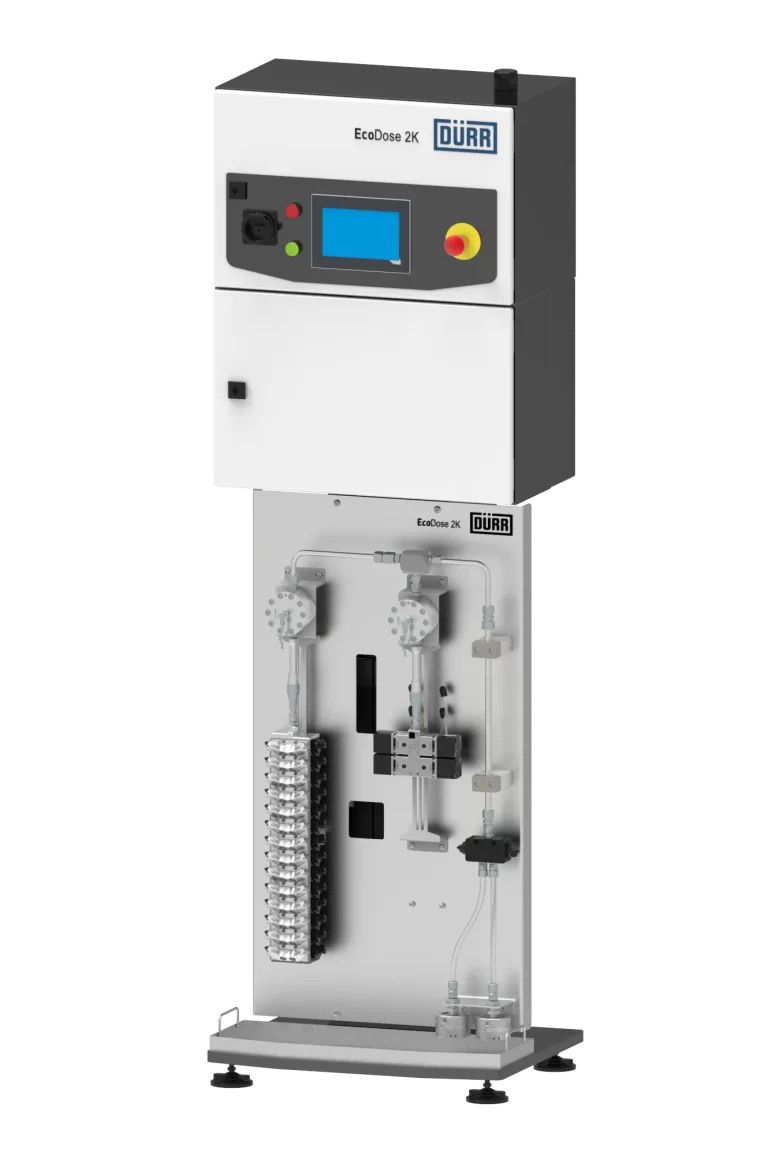
2K and 3K dosing systems in paint processes
Stable dosing for reproducible paint processes
In industrial coating processes, quality variations frequently occur during the mixing phase of coating systems. Automatic 2K and 3K dosing systems aim to avoid this by metering components precisely and repeatably just before application.
Why process stability is crucial
A dosing system functions optimally when the basic process conditions are stable.
Important factors include:
- air quality and filtration
- temperature and relative humidity
- cabineflow
- consistent application settings
When these parameters are under control, a dosing system can help to stabilise mix ratios and application conditions. This aligns with broader automation in the coatings industry.
The role of 2K systems
2K systems mix two components – usually a base component and a hardener – right before application.
This has various technical advantages.
reproducible mixing ratio
Automatic dosing ensures consistent ratios between components.
Lower material waste
Because mixing only takes place at the point of use, less mixed material remains unused.
Shorter rinse cycles
When systems are correctly designed, colour changes can take place more quickly and solvent consumption is reduced.
Lower reliance on operator experience
Automation reduces the impact of manual operations. Practice-oriented support can be further developed via tailor-made paint application training courses.
When 3K systems are required
Some processes require more components to formulate coatings correctly.
For example, a third component could be:
- thinners
- flexibiliser
- additive
- additional colour component
3K systems make it possible to control more process variables, but typically also require tighter recipe management.
Measurement principles in dosing systems
The accuracy of a dosing system is largely determined by the measurement technology used.
Positive displacement meters
Gear meters measure volumetric flow and are often used with viscous coatings.
Advantages:
- robust technology
- cost-effective
- suitable for stable media
Coriolis meters
Coriolis meters measure mass flow rate and can often also determine density and temperature.
They are mainly used when:
- high accuracy is required
- process conditions vary
- low viscosity materials
- abrasive materials and metallics
The real ROI: reproducibility and data logging
The greatest process improvements arise when dosing systems are combined with process monitoring and logging.
Modern systems offer:
- ratio monitoring
- pot-life monitoring
- recording of material consumption
- automatic flush sequences
These functions make it possible to consistently reproduce application parameters. For monitoring of installations and process reliability, it is also maintenance for industrial coating processes relevant.
Practical checklist
A number of factors determine whether a dosing system delivers maximum value.
- define quality indicators such as film thickness and defect ratio
- analyse material consumption per m²
- map out flush cycles and colour changes
- select measurement technology based on viscosity and flow rate
- log process parameters for analysis
Getting started
For paint shops striving for more stable processes and less material waste, 2K and 3K dispensing systems can play an important role. The greatest benefits arise when mixing, application and process monitoring are viewed as one integrated system.
TLCA supports companies with the selection of measurement principles, system integration and process optimisation relating to dosing technology. More technical articles can be found at TechTalk on paint technology and spraying techniques. For questions, please contact Contacting TLCA.
Briefly: 2K and 3K dosing systems dispense components just before application to keep mixing ratios and application conditions more stable. The value of these systems is linked to process stability, correct measurement technology, monitoring, and logging. In painting processes, they support reproducibility, less unused mixed material, and better control over process parameters.
Source: TLCA.
FAQ
What does a 2K dosing system do in a painting process?
A 2K dispensing system mixes two components, usually a base component and a hardener, just before application.
When is a 3K dosing system required?
A 3K dosing system is required when a third component, such as thinner, flexibiliser, additive or additional colour component, needs to be added in a controlled manner.
What does the accuracy of a dosing system depend on?
The accuracy depends largely on the measurement technology used, such as positive displacement meters or Coriolis meters.
2K and 3K dosing systems support more stable paint processes by precisely dosing components just prior to application. The greatest value is achieved when process conditions, measurement technology, monitoring and logging are viewed together.