Robotisation in paint application: when automation truly creates value
Anyone who works with a paint line daily knows it: the biggest enemy of quality is variation. A significant portion of that variation originates from manual application. Not because operators lack craftsmanship, but simply because every human has limitations. Robots can push those boundaries – but only when the process conditions allow it.
In this article, we explain when robotisation in paint application is technically sensible, what quality benefits it yields, what alternatives exist to complete robot cells, and when an investment in robotisation actually won't help you further.
Would you like to know first where variation in your wet paint line comes from? Read our article about the 5 silent profit eaters in wet paint application.
What robotisation actually delivers
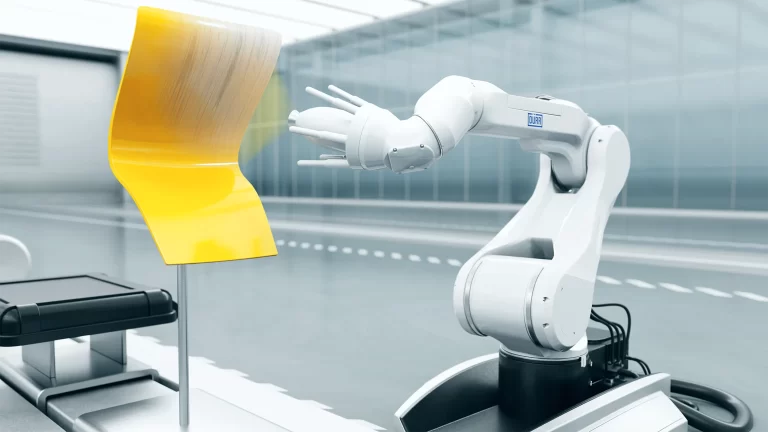
Robot-guided paint application brings three tangible benefits: consistent repeatability, reduced overspray and material loss, and a stable layer thickness from the first to the last production run. In processes where quality directly impacts cost price or customer satisfaction, those benefits are not a side issue – they are decisive.
When does robotisation make technical sense?
Not every painting process is ready for automation. Robot application yields the best returns when three process characteristics coincide:
- High production volumes: Small efficiency gains add up significantly with large volumes.
- Repeatable geometries: a robot operates optimally when spray paths are consistently reproducible.
- Rigorous quality standards: consider controlled layer thicknesses or facing work where every deviation is visible.
Are those three elements present? Then automation offers a real advantage: less variation between operators, better process control and a more stable final quality.
The quality benefits in practice
A robot works with fixed, pre-programmed parameters – spraying distance, speed, overlap and spray pattern – which do not depend on who is in the booth that day. That delivers three concrete benefits:
Constant film build
A uniform film thickness avoids risks of insufficient protection, runs, sags and excessive material usage. Less rework, less waste.
Stable overlap
Robot paths ensure a fixed overlap between spray patterns, resulting in uniform coverage across the entire surface – even on more complex components.
Complete reproducibility
Every production run proceeds in exactly the same way, regardless of the operator or the time of day. That makes quality assurance a lot simpler.
Find out more about the financial impact of material loss through overspray. Read: Are you injecting profit into the filter? The hidden cost of invisible material loss.
Alternatives to a complete robot cell
Automation doesn't have to mean an immediate major investment. For processes involving standard products, high volumes and simple geometries, reciprocators often a smarter first step. They automate the vertical movement of spray guns without the complexity of full robot programming.
Depending on the process requirements, a cobot (collaborative robot) to offer an interim solution, with human and machine working together in the cabin.
Integration with process components: the key to success
A robot installation only truly delivers a return on investment when it is integrated with the rest of the process. Three components are crucial in this regard:
Material supply
Stable material supply via 2K and 3K mixing systems, ratio and pot-life monitoring, and stable pressure control form the indispensable basis for any automated painting process.
Colour change systems
In multi-colour painting processes, automatic colour change blocks and programmable flush sequences are necessary for rapid and reproducible colour changes without loss of quality.
Cabin conditions
Temperature, relative humidity and airflow directly influence the application process. Those conditions must be stable – even during robotic application.
Are you still running your process on gut feeling? Discover why process measurements form the basis of any sustainable improvement: To measure is to know.
When robotisation offers no added value
Automation is not always the right answer. Robotisation yields little extra benefit when:
- constantly changing the shape or composition of products;
- production volumes are too low to justify the investment;
- process conditions are unstable;
- quality issues primarily stem from poor preparation or insufficient process discipline.
In those cases, targeted process optimisation often a greater and faster return than automation. You can find more insights in our TechTalk.
How do you start an automation journey?
The starting point for any automation decision is an honest process analysis. This covers four elements: the product geometries, the production volumes, the nature and extent of quality variation, and the current process stability. That analysis determines which form of automation – reciprocator, cobot or robot cell – best suits your situation.
Do you also want to bring your team along in the story? Discover our training courses in paint application, completely tailored to your process.
TLCA supports businesses with the complete analysis and integration of automation with mixing systems, colour changes and application conditions. Get in touch to discuss the possibilities for your painting process.
Decision: robotisation works – if the basics are right
Robotisation in paint application offers real benefits: greater repeatability, less material waste and more stable product quality. However, those benefits only come into their own when the process conditions permit: sufficient volume, repeatable geometries, stable booth conditions and a well-integrated material supply.
If that foundation is not present, process optimisation often yields more results than automation. The key lies in an honest process analysis prior to investment.
TLCA guides companies through this analysis and the integration of automation with mixing systems, colour changes, and application conditions. Get in touch and discover what robotisation can mean for your painting process.