
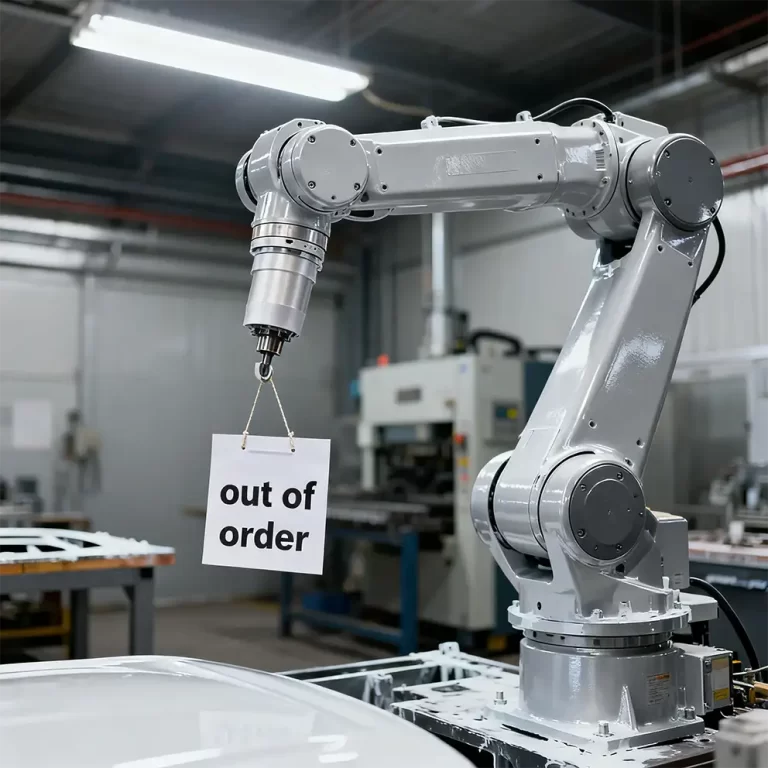
Predictive maintenance in paint lines: less downtime, more delivery reliability
Efficient maintenance for industrial painting processes
Find out how predictive maintenance prevents unplanned downtime in paint lines and increases the operational reliability of your production.
Unplanned downtime is one of the most costly disruptions in industrial production. In paint lines, a failure often affects several process steps simultaneously.
A failure of a pump, valve or other component not only leads to downtime, but often to:
- loss of production
- additional rinsing cycles
- rescheduling of production
- quality risk on restart
Predictive maintenance tries to prevent this by monitoring technical signals before a component fails. This aligns with TLCA's approach around maintenance and repairs for pumps, guns, 2K and 3K installations.
Why classic maintenance strategies fail
Many maintenance programmes still operate according to two models:
Corrective maintenance
Repair when a component fails.
Preventive maintenance
Perform maintenance at set intervals.
Both strategies have limitations.
Corrective maintenance causes unexpected downtime. Preventive maintenance often leads to unnecessary replacement of parts that are still usable.
Predictive maintenance uses measurement data to assess the actual condition of components. More tips and case studies are bundled in TechTalk.
Which installations do you monitor first?
The greatest impact occurs when monitoring is applied to plants with:
- high failure rate
- long recovery time
- direct impact on product quality
In paint lines are typical examples:
- paint supply pumps
- valves and application components
- conveyors and transport systems
- extraction and air treatment
- dosing and mixing systems for two-pack and three-pack coatings
These components often combine mechanical loading with process-critical functions. In paint supply, the choice of high or low pressure pumps in your painting process often a relevant factor.
Three measurement strategies that deliver quick results
Predictive maintenance can start with relatively simple measurement methods.
Operating hours and cycles
For wear components such as seals, valves and gaskets, tracking operating hours provides a good indication of maintenance intervals.
Temperature monitoring
Temperature rise is often a first indication of:
- increased friction
- blockage
- bearing problems
Temperature sensors are therefore often used on motors, pumps and drives.
Vibration analysis
Vibration measurements are particularly effective for rotating parts such as:
- fans
- transport engines
Changes in vibration patterns can detect wear before mechanical failure occurs.
Operational benefits
The biggest gain from predictive maintenance lies in better maintenance planning.
By detecting wear early, companies can:
- perform maintenance during scheduled stops
- ordering parts on time
- avoid emergency repairs
In production environments with continuous coating processes, this often translates into improved delivery reliability and reduced production losses.
Practical start: a small but targeted approach
A predictive maintenance programme usually starts with a limited scope.
A practical approach consists of:
- Identify the main sources of interference.
- Determine the cost of downtime per hour.
- Collect failure data over several months.
- Designate a person responsible for analysis and follow-up.
These steps allow predictive monitoring to be targeted where the impact is greatest.
Getting started
For many paint lines, predictive maintenance can start with monitoring a small set of critical components. Measurements of operating hours, temperature and vibration often provide enough information to better plan maintenance.
For dosing and mixing systems, you can also 2K and 3K dosing technology in modern paint processes help support process control and repeatability.
TLCA helps companies set priorities and create a maintenance strategy that reduces unplanned downtime without complex digitisation projects. In paint lines where colour changes and rinse cycles weigh, it is also relevant at EcoSupply P Core and colour changes in the paint line. Those wishing to check this against their own situation can Contacting TLCA.
Source: TLCA (tlca.be).
FAQ
What is predictive maintenance in paint lines?
Predictive maintenance monitors technical signals to detect component failure before downtime occurs.
Which measurements can you easily start with?
Operating hours and cycles, temperature monitoring and vibration analysis.
Which components often give the biggest impact?
Paint supply pumps, valves and application components, conveyors, extraction and air treatment, and 2K and 3K dosing and mixing systems.
Predictive maintenance offers a data-driven solution to reduce unplanned downtime in paint lines. By monitoring critical parameters such as temperature and vibration, companies can proactively plan maintenance and increase operational reliability.