
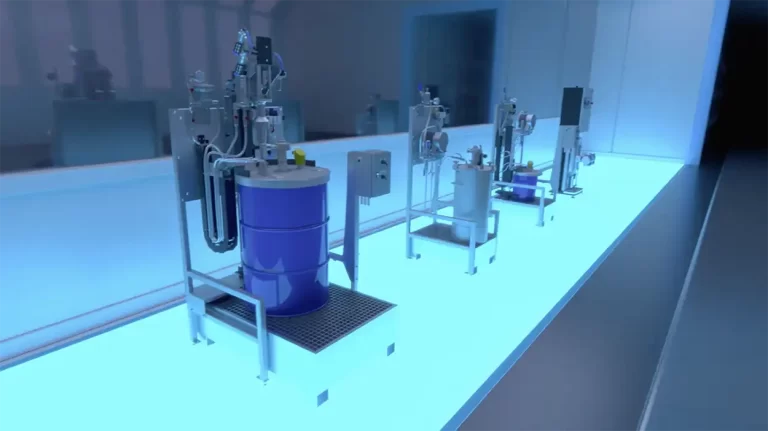
Why modern paint processes choose 2K & 3K dispensing technology: stability, flexibility and less waste
The paint quality that customers expect today is no longer achieved with old-fashioned mixing in a jar or manual dosing. Today's generation of industrial coatings demands tight mixing ratios, stable material behaviour and a process that remains reproducible from morning to last shift.
2K and 3K dosing systems have become an indispensable link in modern production environments for exactly that reason.
It is not about “technology for technology's sake”, but about process security.
What a 2K system solves
In a 2K process, two components are only brought together just before application. This way you avoid:
- premature reaction of coating
- potlife loss
- material waste
- quality variations due to manual mixing errors
A 2K system provides:
- constant mixing ratio, irrespective of viscosity or temperature
- stable material behaviour at gun or robot
- shorter rinsing cycles and faster colour changes
- less waste and less hardener consumption
Automation here means above all: calmness in the process. No guesswork, no variations between operators, no half mixing pots disappearing into the waste container.
Where 3K differentiates
A 3K system adds a third component: for example, pigment, flexibiliser, catalyst or other additive that closely determines the final result or processing window.
That third component brings new benefits:
- much larger colour and formulation range without additional mixing set-ups
- dosing additives at micro flow rates without manual variation
- higher uniformity with critical topcoats
- more flexibility in production planning
For companies that need to incorporate more and more variants, shades or special features into their coatings, 3K is the logical evolution.
And the meters? They enhance the process, but do not define it
The measurement method is not an end in itself, but supports the process.
Gear meters:
- ideal for main components in 2K
- robust, reliable and stable at typical A/B flowranges
- economic choice when materials are not extremely variable or abrasive
Coriolis meters:
- measure mass instead of volume
- no wear, high precision
- perfect for low flow rates and sensitive components
- therefore the standard for the third channel in 3K
The point is not that one is “better” than the other. The point is: use the right technology for the right material behaviour.
In most processes, a gear gauge does exactly what is needed. When materials become thinner, more sensitive or more critical, Coriolis offers extra security. But the real value is still in the entire dosing and mixing process, not in the measuring element alone.
The real benefits for production environments
1. Less waste
Mixing only what you consume means:
- less paint waste and consumption
- lower disposal and flushing costs
- higher durability
2. Reproducible quality
A 2K/3K system mixes:
- within exactly the same ratio
- with the same viscosity and temperature
- without human variation
Each shift gets the same output conditions.
3. Faster colour and product changes
Because materials only come together at the end, the plant remains cleaner and rinse cycles are shorter.
4. Better process control
Operators and robots get a coating that responds consistently, leading to:
- even layer thicknesses
- more stable spraying process
Conclusion
2K and 3K dosing systems are much more than a technical detail. They are the basis of a stable, flexible and cost-efficient coating process.
Gear and Coriolis meters play a part in that story, but they support the big picture: better mix quality, higher reproducibility, less waste and more control over the end result.
That is why more and more companies are moving towards automated mixing systems. Not because they can, but because it makes the whole paint process more reliable.
Source: TLCA.
FAQ
1) Specifically, what does a 2K system solve?
A 2K system only mixes just before application, reducing potlife losses, manual mixing errors and material wastage.
2) When is 3K the logical next step?
When you work with more variants, shades or special additives and need extra flexibility in formulation and planning.
3) Where can I find more context on installation requirements and practical operation?
See ATEX and machinery directive at spraying plants and paint kitchens and the tailor-made paint application training courses. For questions: contact us.

2K and 3K dosing systems support a reproducible coating process by mixing components only just before application. This reduces waste, shortens rinse cycles and increases process control. With 3K comes additional flexibility via a third component for variants and additives.